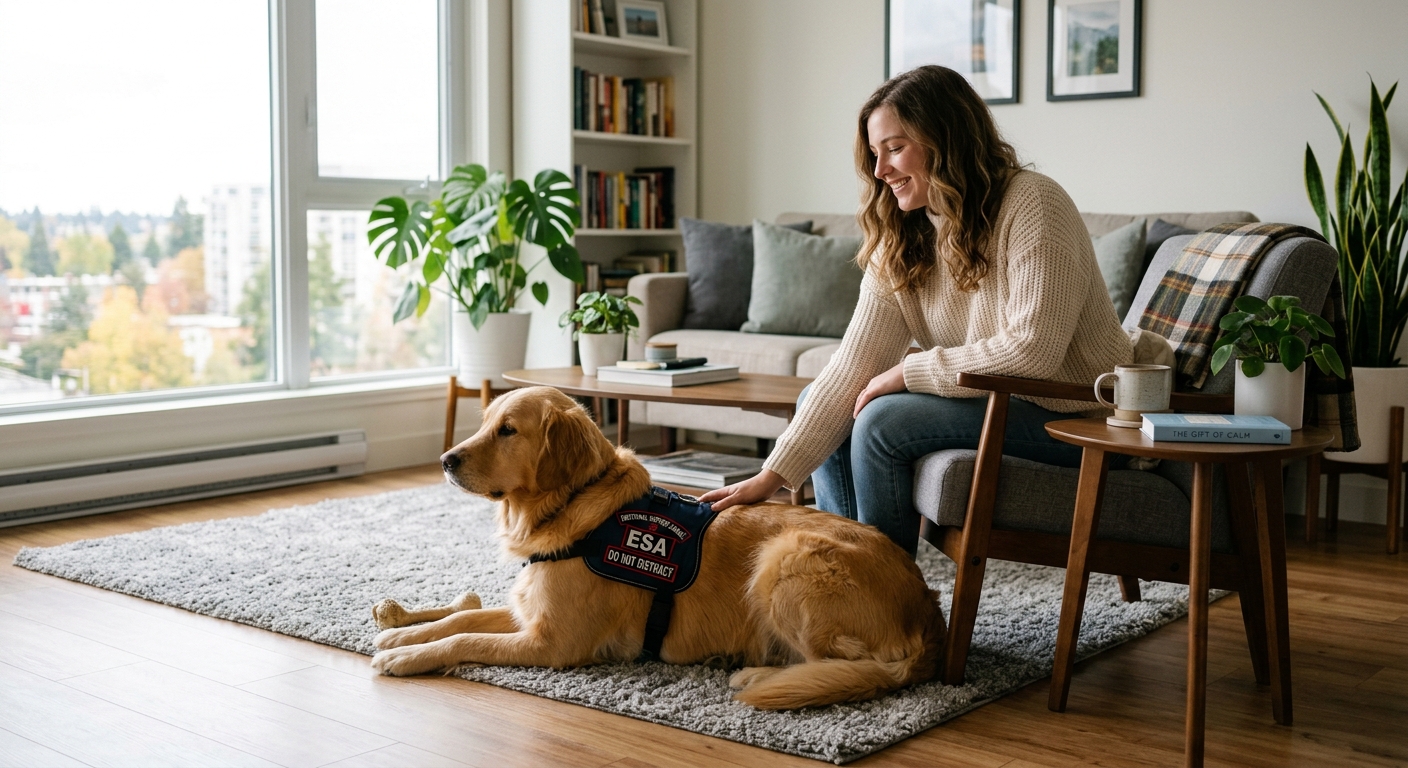
An ESA letter for autism is documentation from a state-licensed clinician that can support a reasonable-accommodation request to live with an emotional support animal in housing that otherwise limits pets. Autism may be relevant when it substantially affects major life activities and the animal helps with that need; a letter is issued only after a real clinical evaluation, not after a form that always produces the same document. Clinical Support Animals provides a thorough evaluation by state-licensed clinicians, listed at about $149 on the live qualify page on November 16, 2026. Start at qualify. This article cannot diagnose you, and the letter does not have to name a diagnosis.
Autistic adults — and, when a clinician agrees it is appropriate, families supporting an autistic resident (for a minor, a parent or legal guardian must be involved, and eligibility depends on the provider's policy and the clinician's judgment) — sometimes look for housing documentation because the animal is already part of a daily regulation routine: sleep, transitions, or the residual stress of a noisy building. That lived experience matters. It is not, by itself, a letter. A state-licensed clinician still has to evaluate the disability-related need and decide whether to issue documentation.
Clinical Support Animals is built for people who want that evaluation done carefully, not as a rushed template. The brand's position is a thorough clinical review at about $149, as described on qualify.
What an ESA letter can and cannot do in this context
A housing letter can support a request to keep an animal as a reasonable accommodation under applicable fair housing rules. It does not:
- Have to disclose an autism diagnosis, or any specific diagnosis, on the page the housing provider sees
- Function as a public-access credential for stores, restaurants, or flights
- Excuse damage, noise, or unsafe behavior
- Apply automatically to every building; some small or owner-occupied housing may be outside federal fair housing rules
- Require a housing provider to accept an animal that poses a direct threat or would cause an undue burden
Housing providers may verify the clinician's license and may ask reasonable follow-up questions. You remain responsible for the animal's care.
An emotional support animal is also not an autism service dog. A service dog is individually trained to perform tasks and is covered by the ADA; an ESA is not a service animal under the ADA and has no public-access rights. If your question is really about a psychiatric or autism service dog rather than an ESA, that is a different category and training standard. See our psychiatric service dog letter for housing article and do not treat the two as interchangeable.
Ready for your ESA housing letter?
A licensed clinician reviews your free 3-minute screening.
Start Your Free ScreeningWhy a thorough evaluation is the point
Autism presents differently from person to person. Sensory load, social exhaustion, executive function, and co-occurring anxiety or mood symptoms can all be part of the picture, or none of them might be the reason an animal helps. A careful clinician will ask what actually happens in the home, not only whether you have a label.
That is also why a registry membership, a vest, or an unofficial ID card is not a substitute. There is no official ESA registry, and those products are not legal requirements. Our explanation of why registries are not a substitute for a letter is the right companion if that is what you have been offered.
Clinical Support Animals describes a private clinical evaluation on qualify and in your private and safe online evaluation. Come prepared to talk about function, not only about a past assessment.
How the request usually goes after a letter is issued
- You complete the Clinical Support Animals process and, only if the clinician decides you qualify, you receive a signed letter with license details a housing provider can verify.
- You send a short written accommodation request with the letter, naming yourself, the unit or application, and the animal — not a medical history.
- The housing provider reviews the request, may verify the license, and should respond in a reasonable time under applicable law.
- You keep copies of what you sent and of any written reply.
If you rent from a private landlord, a condo board, or a public-housing setting, the paperwork habit is the same even if the office looks different. Related guides include ESA letter for a private landlord and ESA letter for Section 8 housing. Use those when they match your housing type; do not assume every rule is identical.
Nationwide, without treating any one state as the story
Clinical Support Animals works with state-licensed clinicians. Your location matters because licensure and some state documentation rules follow the state where you live or are moving. The evaluation is still an evaluation, not a regional promotion. If you are moving, say so clearly so the clinician's license matches the housing that will actually review the letter.
We will not restate contested or dated federal-guidance slogans here. Fair housing rules may apply to your request; outcomes depend on the facts and current law.
Price and refund terms, stated carefully
The live qualify page on November 16, 2026 describes a thorough evaluation by state-licensed clinicians at about $149. Please confirm the exact total, including any tax, during the qualify flow. The live Terms of Service, checked November 17, 2026, describe a refund if you don't qualify. Read the current terms when you apply.
A letter is not issued simply because a payment went through. If the clinician does not find a qualifying need, you should not expect a letter, and you should rely on the written refund terms then in force.
Preparing for the evaluation without over-rehearsing a script
A thorough evaluation goes better when you can describe ordinary days, not only a polished summary. Think about mornings, transitions, sleep, noise in the building, and what changes when the animal is present or absent. If a previous assessment exists, you can have it available; you do not need to memorize it. If a family member helps you organize the appointment, they should not answer every question for you unless the clinician asks for collateral information and you agree.
It also helps to know your housing timeline. An application, a renewal, or a move date is useful context. It is not a reason to pressure a clinician into a particular outcome. The clinician's job is the clinical decision. Yours is to make a clear, timely request once you have documentation, and to keep copies.
If communication itself is tiring, say so at the start of the process so the team can work with written steps, longer pauses, or a quieter format when that is available. A thorough evaluation should accommodate the person in front of the clinician, not only produce a standard paragraph.
After you have a letter: keep the file usable
Save the PDF, the date you sent it, and any written reply in one place you can find later — including if you need a copy during a renewal or a future move. If a housing provider asks a reasonable follow-up question, answer it without expanding into a medical narrative. If they ask for something that feels like a full records request, pause and get advice rather than forwarding a complete clinical history under pressure.
Renewal is a separate moment. Many providers want a current letter. Plan for that before the old date lapses, rather than treating the first letter as permanent. The Clinical Support Animals qualify process is also the place to start a later evaluation if you need one.
Frequently asked questions
Can an autistic person get an ESA letter for housing?
A state-licensed clinician may issue a letter if they evaluate you and find a disability-related need for the animal. Autism can be relevant; it is not an automatic outcome, and this article is not a diagnosis.
Will the letter say that I am autistic?
It does not have to name a diagnosis. It needs to document a disability-related need in a way a housing provider can review without receiving your full medical file.
How much does a Clinical Support Animals evaluation cost?
About $149 for a thorough evaluation by state-licensed clinicians, as shown on the qualify page on November 16, 2026. Confirm the exact amount during qualify.
Is this the same as a service dog letter?
No. An ESA letter supports a housing accommodation. A psychiatric service dog is a different category, with different public-access and training issues. See our PSD housing-letter article if that is your situation.
What if I already have a past diagnosis?
You may share it with the clinician if you wish. The clinician still has to evaluate the current need. A past report is not a housing letter by itself.
How do I start?
Begin at qualify. Use a private space, and be ready to describe how the animal helps in daily life rather than only repeating a label.
Start a thorough evaluation with Clinical Support Animals
If you are seeking an ESA letter for autism, the useful next step is a careful evaluation by a state-licensed clinician, not a registry or a vest. Clinical Support Animals is set up for that thorough review. Go to qualify when you are ready to begin.