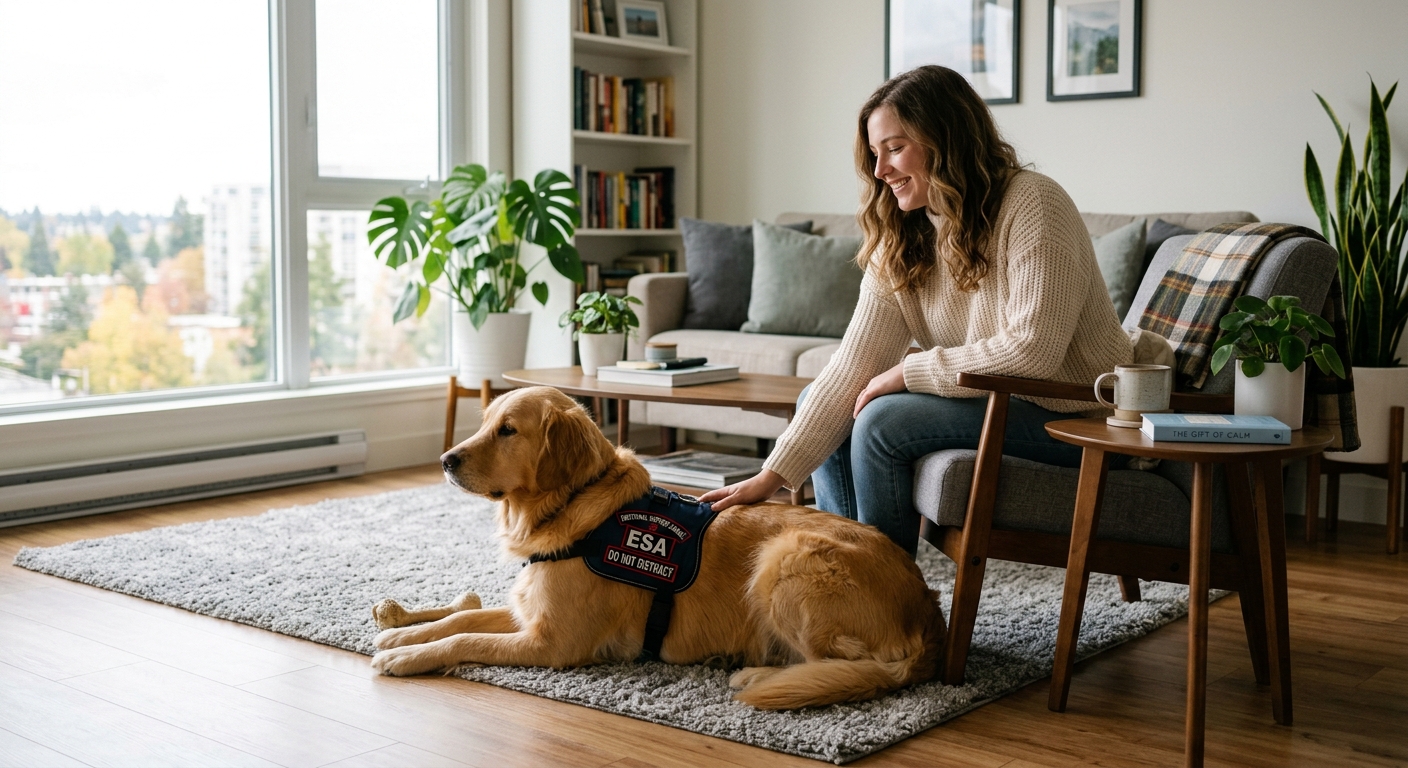
A psychiatric service dog (PSD) letter for housing is documentation from a licensed mental health professional confirming that you have a mental health condition and that your dog is trained to perform tasks that help with it. You can share it with a housing provider when you request a reasonable accommodation for your dog.
The key difference from an emotional support animal is training: a psychiatric service dog performs specific tasks, such as interrupting a panic attack or providing deep pressure during anxiety. This guide covers what a PSD letter includes, how it compares with an ESA letter, and how to get a clinician-led evaluation.
What a PSD letter for housing includes
- The clinician's name, license type, license number and issuing state.
- The date of the evaluation and the clinician's signature.
- A statement that you have a condition that limits a major life activity.
- A statement that your dog helps with that condition.
- Contact details so the housing provider can confirm the letter.
A PSD letter does not need to list your diagnosis.
Ready for your ESA housing letter?
A licensed clinician reviews your free 3-minute screening.
Start Your Free ScreeningPSD letter vs. ESA letter
| Psychiatric service dog | Emotional support animal | |
|---|---|---|
| Animal type | Dog | Any common household animal |
| Training | Trained to perform specific tasks | No task training needed |
| Main role | Performs tasks that help with a mental health condition | Provides comfort through companionship |
| Housing | Accommodation request with documentation as needed | Accommodation request with an ESA letter |
| Travel | Broader options under air travel rules | Treated as a pet by most airlines |
Still deciding? Read our ESA vs. psychiatric service dog guide.
Examples of psychiatric service dog tasks
- Deep pressure therapy during anxiety or panic.
- Interrupting repetitive or self-harming behaviors.
- Waking a handler from nightmares.
- Reminding a handler to take medication.
- Creating space in crowded areas.
- Guiding a handler to a quiet, safe spot.
Your dog's tasks should connect directly to your needs. If your dog is still learning, see our guide to supporting a PSD in training at home.
How to get a PSD letter for housing
- Take the free clinical screening. Answer questions about your symptoms and how your dog helps.
- Meet a state-licensed clinician. They review your history and how your dog's tasks support you.
- Receive your letter if you qualify. Your documentation includes the clinician's license details.
- Share it with your housing provider. Send it with a short, polite accommodation request.
Sharing your PSD letter with a landlord
Send your request in writing and keep a copy. A short note works well: explain that you are requesting a reasonable accommodation for your psychiatric service dog and attach your letter. Many housing providers respond within a couple of weeks. For move-in timing, read protecting your PSD's housing rights from day one.
Why choose a clinician-led evaluation
Clinical Support Animals offers a premium evaluation by state-licensed clinicians, at about $149. It is a thorough clinical review rather than an instant certificate, which gives housing providers clear, verifiable documentation. If you are moving from an ESA to a PSD, our ESA to PSD guide explains the steps.
Preparing for your evaluation
- Write down the symptoms that affect your daily life, such as sleep, focus or anxiety in public.
- List the tasks your dog performs and how each one helps you.
- Note how long your dog has been trained and who trained them.
- Have your housing details ready, including your landlord or property manager's contact.
Being prepared helps the clinician understand your needs and makes the appointment efficient.
Common questions from housing providers
Housing providers may review reliable documentation when the need is not obvious. They may ask to confirm the clinician's license or contact them to verify the letter. They should not ask for your diagnosis or medical records. Keeping a copy of your letter and every message you send helps if questions come up later.
Your dog should be well behaved and under your control, and standard building rules about noise and cleanup apply.
Travel and other settings
A PSD letter is focused on housing. If you also travel with your dog, airlines have their own forms and rules. See our ESA and PSD air travel guide for the current process.
Keeping your documentation current
Many housing providers prefer documentation that reflects your current situation. Reviewing your letter each year, or before a move, keeps your request clear and easy to approve.
What makes a PSD letter easy to verify
Housing providers move faster when documentation is clear. A strong letter lists the license number and state, is signed and dated, and gives a phone number or email for confirmation. It describes your need in plain language without sharing private medical details. Clinical Support Animals letters are written with these elements so property managers can review your request with confidence.
If a housing provider reaches out, a quick, polite reply with any requested license details usually resolves questions in a day or two.
Your rights and responsibilities as a PSD handler in housing
A PSD letter supports a reasonable accommodation request, and the request works best when both sides know what to expect. In general, a housing provider may ask for reliable documentation when a disability or the need for the animal is not obvious, but should not ask for your diagnosis or medical records. Many providers also cannot charge a pet deposit or pet rent for an assistance animal, although you can still be responsible for any damage the dog causes.
- Keep your dog under control in shared spaces such as hallways, elevators and laundry rooms.
- Clean up after your dog and follow the same waste rules as other residents.
- Follow local licensing and vaccination rules for dogs in your city or county.
- Respond to reasonable questions in writing so you have a record of every exchange.
Rules differ by property type and location, so if a request is denied or you are unsure how a rule applies, a local fair housing organization can explain your options.
How a PSD request usually unfolds, step by step
- Screening. You complete a short screening so a clinician can see whether a PSD letter fits your situation.
- Evaluation. A state-licensed clinician reviews your history and how your dog helps with specific tasks.
- Letter. If you qualify, you receive a signed letter with the clinician's license details.
- Request. You send the letter to your landlord or property manager with a short written accommodation request.
- Review. The housing provider may confirm the clinician's license and reply in writing.
- Follow-up. If more information is requested, you or the clinician respond without sharing private medical details.
Keeping copies of every message, and noting the date you sent each one, makes it easier to follow up if a reply is slow.
Common mistakes to avoid
- Buying a registry ID or vest instead of documentation. Registrations and patches are not the same as an evaluation by a licensed clinician.
- Waiting until move-in day. Sending your request when you apply gives the housing provider time to review it.
- Sharing more medical detail than needed. The letter is designed to explain your need without listing a diagnosis.
- Overstating training. Describe the tasks your dog actually performs, in plain words.
Avoiding these mistakes keeps the conversation focused on your need and helps your request move forward smoothly.
Get started today
The screening is free and takes a few minutes. Start your clinical screening to see whether a PSD or ESA letter fits your needs.
Frequently asked questions
What is a PSD letter for housing?
It is documentation from a licensed mental health professional confirming your condition and that your dog is trained to perform tasks that help with it.
Is a PSD letter the same as a service dog certification?
No. There is no required national certification. A PSD letter is a clinician's documentation of your need.
Does my dog need to be trained to qualify as a PSD?
Yes. A psychiatric service dog is trained to perform specific tasks related to your condition.
Does a PSD letter list my diagnosis?
No. It states that you have a qualifying condition and that your dog helps with it, without naming the diagnosis.
How much does a PSD evaluation cost at Clinical Support Animals?
The premium evaluation by a state-licensed clinician is about $149.
Can I get an ESA letter instead?
Yes. If your animal provides comfort rather than trained tasks, an ESA letter may fit better. The free screening helps you choose.
Can a landlord charge a pet deposit for a psychiatric service dog?
In many housing situations, assistance animals are not treated as pets, so pet deposits and pet rent usually do not apply. You can still be responsible for damage. Rules vary, so check with a local fair housing organization if you are unsure.
How long does it take to get a PSD letter?
It depends on scheduling with a clinician. Starting with the free screening is the quickest way to see whether a PSD letter fits and what the next step is.